
















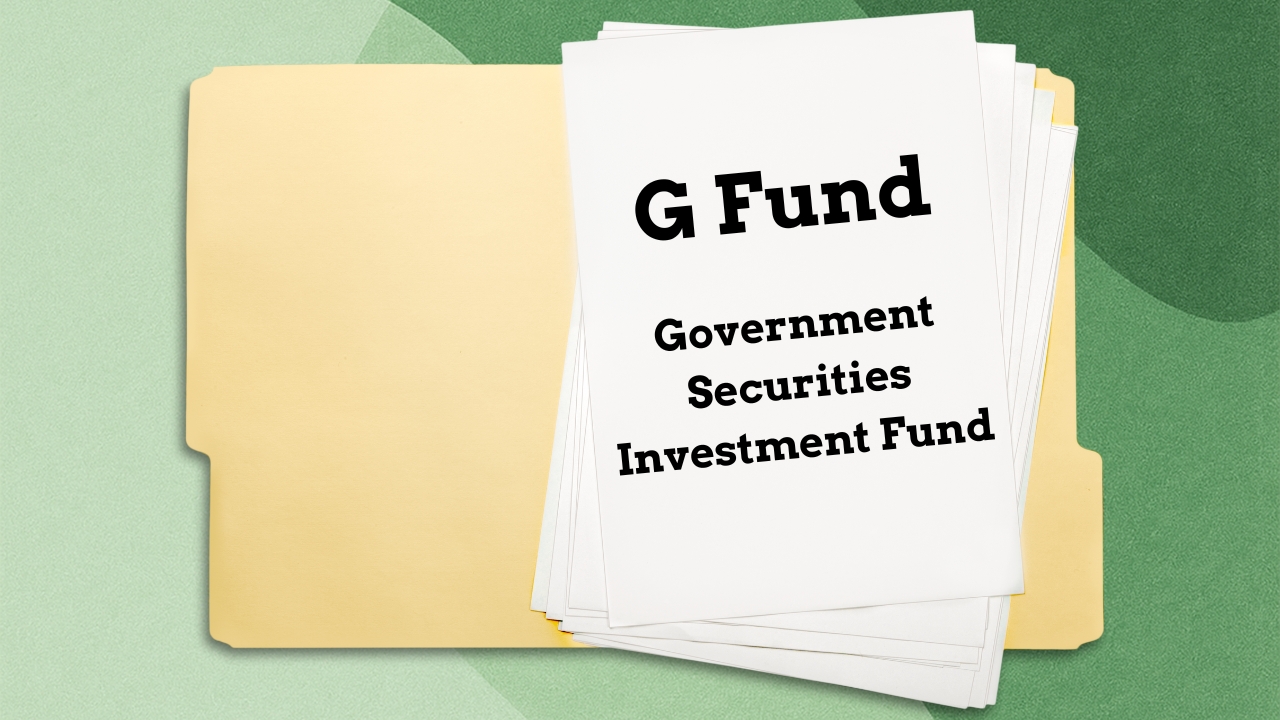

The Thrift Savings Plan (TSP) G Fund operates differently from anything else in the lineup. It invests in special-issue U.S. Treasuries exclusive to TSP, credits interest daily, and never loses value due to market swings. With higher rates, the TSP G Fund interest rate in 2026 has made those “cash-like” returns attractive for risk control.
A solid retirement paycheck needs more than just safety, though. You need the right balance between attempting to protect what you have and letting part of your money grow.
When people say the G Fund is “risk-free,” they mean it won’t lose value if the market tanks. Your balance stays put when stocks or bonds take a hit.
But protection has limits. Inflation erodes your buying power, and a balance that never drops can still fall behind if it doesn’t keep up with rising costs and steady withdrawals.
That’s the core of the G Fund vs. C Fund long-term debate. The G Fund protects you from month-to-month market noise and gives you stability when things get rocky. The growth funds – C, S, and I – are designed to help your money outpace inflation and support an income that lasts for decades, not just a few years. Choosing only G means less risk of short-term loss, but it can also mean potentially missing out on the long-term growth you need for a financially confident retirement.
The G Fund works best when you use it deliberately.
It’s ideal for near-term spending. If you know you’ll need money in the next 6-24 months, keeping it in G reduces sequence-of-returns risk and gives you one less thing to worry about when the market gets choppy.
It also makes sense if you genuinely can’t stomach volatility. Some people have low risk tolerance or limited risk capacity – maybe you’re close to retirement, or market swings keep you up at night. A reasonable G allocation can help you avoid panic decisions.
The G Fund can also serve as a rebalancing anchor. When stocks drop, having some G Fund on hand means you can shift money into C, S, or I at lower prices instead of selling in a downturn.
Problems start when G stops being a tool and becomes the entire toolbox. Too much G fund means potentially missing the growth from C, S, I, and F, risking that you won’t have enough for a long retirement.
Another issue is drift. A lot of federal employees default on their contributions to G over time, often without realizing it. That quietly undercuts compounding, and by the time you notice, you’ve lost years of potential growth.
Matt Kramer, an advisor at Serving Those Who Serve (STWS), recently dug into the G Fund returns and found that not all is what it seems. If you’re leaning heavily on G right now, his analysis is worth a read.
Your “safety bucket” – G and F combined – should match your actual spending horizon. Money you’ll need in the next couple of years? Keep it safe. Goals that are seven to ten years out or longer? Consider putting those funds in growth assets like C, S, and I.
If you want to simplify things, the L Funds can automatically balance your account. Or set up a basic policy mix and rebalance on a schedule or when your allocations drift more than 5% off target.
Finally, check your contribution allocations. Make sure new money isn’t just piling up in G by default.
Figure out how much cash you’ll actually need over the next 12-24 months, and make sure that amount is sitting in G or F.
Then take a look at your current mix and compare it to your target. If G has crept up because of fear or inertia, fix it now.
Finally, put a reminder on your calendar to review your plan after big life changes – retirement, a health issue, a pension decision – not after a bad week in the markets.
The TSP G Fund interest rate for 2026 has improved, and the fund continues to deliver stability without the daily drama of market swings. But stability by itself won’t carry you through a long retirement.
Size your G allocation to cover near-term cash needs and help give yourself financial confidence. Then let diversified growth handle everything else. The G Fund vs. C Fund long-term tradeoff only works when both funds are doing their jobs.
If you want a second set of eyes on your allocation, reach out to the Serving Those Who Serve team at [email protected].
The information has been obtained from sources considered reliable but we do not guarantee that the foregoing material is accurate or complete. Any opinions are those of Serving Those Who Serve writers and not necessarily those of RJFS or Raymond James. Any information is not a complete summary or statement of all available data necessary for making an investment decision and does not constitute a recommendation. Investing involves risk and you may incur a profit or loss regardless of strategy suggested. Every investor’s situation is unique and you should consider your investment goals, risk tolerance, and time horizon before making any investment or financial decision. Prior to making an investment decision, please consult with your financial advisor about your individual situation. While we are familiar with the tax provisions of the issues presented herein, as Financial Advisors of RJFS, we are not qualified to render advice on tax or legal matters. You should discuss tax or legal matters with the appropriate professional. **
The Thrift Savings Plan (TSP) is a retirement savings and investment plan for Federal employees and members of the uniformed services, including the Ready Reserve. The TSP is a defined contribution plan, meaning that the retirement income you receive from your TSP account will depend on how much you (and your agency or service, if you’re eligible to receive agency or service contributions) put into your account during your working years and the earnings accumulated over that time. The Federal Retirement Thrift Investment Board (FRTIB) administers the TSP.
The FedLife Podcast is your in-depth, biweekly deep dive into the world of federal benefits and retirement planning. Hosted by federal benefits expert Ed Zurndorfer and Dan Sipe of Serving Those Who Serve, each 30-minute episode unpacks the complexities of FERS and CSRS retirement, FEHB and Medicare, survivor benefits, tax planning, and more. Designed for federal employees and retirees who want more than just the basics, FedLife goes beyond the headlines to explore the rules, nuances, and strategies that can make a meaningful difference in your retirement. Remember: it’s your Fed life, make it a great one.
The Fed15 Podcast is your weekly 15(ish)-minute briefing on federal benefits and financial planning, built specifically for federal employees and retirees. Hosted by Dan Sipe and Katelyn Murray of Serving Those Who Serve, each episode delivers clear, actionable guidance on topics like FERS and CSRS retirement, TSP strategies, FEHB, survivor benefits, tax planning, and more! Whether you’re five years from retirement or already there, The Fed15 helps you cut through the noise, avoid costly mistakes, and make confident decisions about your federal benefits.