


















For federal employees, retirement planning involves a number of moving pieces. Between FERS, TSP, FEGLI, FEHB, and more, there’s more than enough alphabet soup to go around for Feds.
With so much attention devoted to the benefits unique to federal employment, however, Social Security can sometimes receive less attention than it deserves. For most FERS employees, though, Social Security is a critical component of the overall retirement income picture. One of the best places to begin understanding that benefit is your Social Security Statement.
The Social Security Administration recently redesigned its benefit statement to make it shorter, easier to read, and more useful for retirement planning. The redesigned version uses plain language, visual elements, and clearly separated sections to help workers quickly find their earnings history and estimates of future benefits. Statements are available online at www.ssa.gov.
In this article, we’ll take a closer look at the redesigned Social Security Statement and discuss how federal employees can use it to review their earnings history, benefit estimates, and other important information.
Start With the Retirement Benefit Estimate
The most prominent feature of the new statement is the Personalized Monthly Retirement Benefit Estimates section. Instead of focusing on a single projected benefit, the Statement uses a bar graph to show estimated monthly benefits at up to nine different ages at which you could begin receiving Social Security:
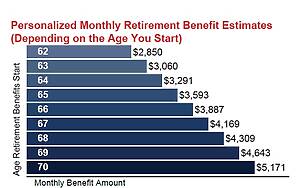
This presentation is particularly useful because the age at which you claim Social Security is itself a retirement-planning decision. For example, a federal employee might retire from government service at age 62 but decide to wait several years before claiming Social Security. During that period, the employee could rely on cash reserves and retirement account distributions to supplement income. Another employee might claim Social Security earlier and use it alongside the FERS annuity to reduce the amount withdrawn from their portfolio.
Importantly, the statement does not tell you which strategy is right. What it does provide is a starting point for understanding how your Social Security income changes depending on when you claim. That distinction matters. Your Social Security estimate is not your retirement-income plan. It is just one of the (many!) inputs to that plan.
When reviewing your estimate, pay attention to the assumptions behind it. Your projected benefit is based on your earnings record and assumptions about future earnings. If you are nearing retirement and expect to stop working before claiming Social Security, your actual circumstances may differ from the assumptions used to generate the estimate.
For that reason, it can be useful to supplement the Statement with the benefit calculators available through your my Social Security account. SSA specifically designed its online portal to give workers access to their statement and additional retirement-planning resources.
It’s also worth mentioning that your FERS annuity and Social Security benefits are separate pieces of your retirement income. Your Social Security Statement is not showing you what your FERS pension will be. It is only showing you the Social Security benefit associated with your Social Security-covered earnings.
Your Earnings History May Be the Most Important Part
The benefit estimates tend to get the most attention, but federal employees should not overlook the Earnings Record section.
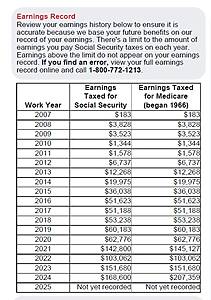
Your Social Security benefits are based on your highest 35 years of earnings; if you have fewer than 35 years of earnings, years without earnings can count as zeros in the calculation. The redesigned statement makes that history easier to review and explains how to report an error if you find one. SSA recommends reviewing your earnings record at least once a year.
This is not merely an administrative exercise. An incorrect or missing year of earnings can have a meaningful impact on your eventual benefit calculation. If you find an error, address it rather than assuming it will eventually correct itself. SSA explains how to report errors and provides access to your complete earnings history through your online account.
Don’t Skip the Other Sections
The redesigned Social Security statement also provides information beyond retirement benefits. Depending on your circumstances, it can show estimated disability and survivor benefits, as well as information related to Medicare. These sections can be especially relevant when you’re looking at your household’s broader financial plan.
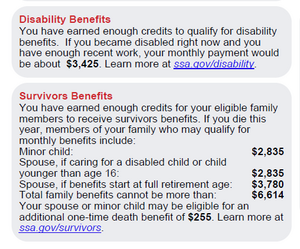
Survivor benefits can be part of the financial protection available to a spouse or children. That information can be considered alongside your life insurance coverage and other assets when evaluating whether your family would have sufficient resources if you were to die prematurely.
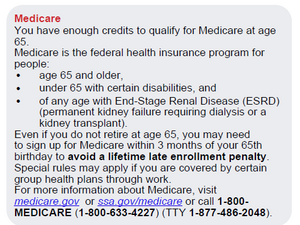
The statement also provides information about Medicare eligibility and directs readers to additional resources. SSA has created supplemental fact sheets tailored to different age groups and circumstances, including information for younger workers, retirement readiness, Medicare and workers who have non-covered earnings.
For someone approaching retirement, those supplemental materials can provide useful context around the numbers in the statement.
One Important Change for Federal Employees
If you’re a Fed who previously thought you did not qualify for a Social Security benefit, there may be a good reason to pull a recent statement.
Some federal workers and retirees have historically had to account for the Windfall Elimination Provision (WEP) and Government Pension Offset (GPO) when evaluating Social Security benefits because they also received a pension from employment that was not covered by Social Security. The Social Security Fairness Act changed that landscape by repealing WEP and GPO for benefits payable after December 2023.
That change makes it especially important not to rely on older Social Security Statements, articles, or retirement-planning assumptions when evaluating your situation. If you have a federal pension or a history of work that was not covered by Social Security, make sure you’re using current information when planning.
Make the Statement Part of Your Financial Review
The redesigned Statement is easier to read, but its real value comes from what you do with the information.
For federal employees, consider reviewing it alongside your FERS retirement estimate, as well as your TSP and other investment account statements. Look at your Social Security benefit at different claiming ages, verify your earnings history, and consider how the resulting income would fit with your expected retirement expenses. If you’re still years from retirement, this exercise can give you a useful sense of where you are headed and whether your current savings strategy is on track. If retirement is imminent, the statement can provide vital input into decisions about when to retire, when to claim Social Security, and how to best coordinate Social Security with your FERS annuity and TSP.
The SSA’s goal in redesigning the Statement was to make a complicated program easier for people to understand. For federal employees, the opportunity is to take that information one step further and put it into the context of the entire retirement plan.
If you haven’t reviewed your Social Security Statement recently, start with three questions:
If you need help decoding your statement or contextualizing your Social Security benefit in your larger retirement plan, feel free to reach out to the Serving Those Who Serve team at [email protected] to schedule a complimentary financial planning consultation today.
The information has been obtained from sources considered reliable but we do not guarantee that the foregoing material is accurate or complete. Any opinions are those of Serving Those Who Serve writers and not necessarily those of RJFS or Raymond James. Any information is not a complete summary or statement of all available data necessary for making an investment decision and does not constitute a recommendation. Investing involves risk and you may incur a profit or loss regardless of strategy suggested. Every investor’s situation is unique and you should consider your investment goals, risk tolerance, and time horizon before making any investment or financial decision. Prior to making an investment decision, please consult with your financial advisor about your individual situation. While we are familiar with the tax provisions of the issues presented herein, as Financial Advisors of RJFS, we are not qualified to render advice on tax or legal matters. You should discuss tax or legal matters with the appropriate professional. **
The FedLife Podcast is your in-depth, biweekly deep dive into the world of federal benefits and retirement planning. Hosted by federal benefits expert Ed Zurndorfer and Dan Sipe of Serving Those Who Serve, each 30-minute episode unpacks the complexities of FERS and CSRS retirement, FEHB and Medicare, survivor benefits, tax planning, and more. Designed for federal employees and retirees who want more than just the basics, FedLife goes beyond the headlines to explore the rules, nuances, and strategies that can make a meaningful difference in your retirement. Remember: it’s your Fed life, make it a great one.

The Fed15 Podcast is your weekly 15(ish)-minute briefing on federal benefits and financial planning, built specifically for federal employees and retirees. Hosted by Dan Sipe and Katelyn Murray of Serving Those Who Serve, each episode delivers clear, actionable guidance on topics like FERS and CSRS retirement, TSP strategies, FEHB, survivor benefits, tax planning, and more! Whether you’re five years from retirement or already there, The Fed15 helps you cut through the noise, avoid costly mistakes, and make confident decisions about your federal benefits.