


















Traditional IRAs are classified into two types: (1) Deductible and (2) Nondeductible. Deductible traditional and nondeductible traditional IRAs have some features in common; for example, any accrued earnings within the IRA (interest, dividends, and capital gains) grow tax-deferred and are fully taxable when withdrawn from the IRA. Both types of IRAs differ in the following way: Contributions made to deductible IRAs are made with before-taxed dollars and when withdrawn from the traditional IRA, are fully taxable together with any accrued earnings. Contributions to a nondeductible traditional IRA are made with after-taxed dollars and are not taxable when withdrawn.
After-taxed dollars in a traditional IRA are known as basis. Basis must be accounted for and if it is not, the traditional IRA owner could end up paying income tax twice; namely. on the funds before they are contributed to the IRA and again when the same funds when withdrawn from the IRA.
It is important for IRA owners to understand that basis in a traditional IRA does not mean cost basis. “Cost basis” is the amount an individual investor pays for an investment. For example, what an investor pays for a stock, a bond, an “open-end” fund or an exchange-traded fund. Cost basis is a completely different concept that does not apply to traditional IRAs. For example, the “step-up in basis” tax rule does not apply to traditional IRAs. “Step-up in basis” is a tax provision that adjusts the cost basis of an investment to its fair market value on the date of the investment owner’s death. The following example illustrates:
Example 1. Michael has $20,000 in after-tax dollars in his traditional IRA. The $20,000 represents Michael’s basis in his traditional IRA. If Michael does not add to the $20,000 basis, then the $20,000 basis remains fixed. This is the case even if his IRA account grows to over a million dollars. Assuming Michael makes no contribution and withdrawals during his lifetime, everything above the $20,000 will be taxable to Michael’s beneficiary(s) upon withdrawal after his death. There is no step-up in basis when Michael dies.
Distribution of Basis: Understanding the “Pro-Rata” Rule
After a traditional IRA owner has contributed after-taxed dollars to a traditional IRA thereby creating basis in the IRA, the owner cannot “cherry pick” only those after-taxed dollars for distribution or to perform a Roth IRA conversion. Distributions from a traditional IRA are subject to the “pro-rata” rule. In particular, each distribution from the IRA will consist of a proportional amount of before-taxed dollars and after-taxed dollars.
For traditional IRAs, the “pro-rata” rule considers all of an individual’s IRA accounts. This includes SEP and SIMPLE traditional IRAs owned as of December 31 of the year of the distribution or conversion. Note that Roth IRAs, inherited IRAs, and employer-sponsored plans such as a 401(k) plan and the traditional TSP are excluded from the pro-rata formula.
The following example illustrates:
Example 2. Lauren, age 63, is a federal retiree. She directly rolled her traditional TSP with $500,000 to a “rollover” traditional IRA. Lauren also has a non-deductible traditional IRA currently worth $100,000 that includes $55,000 of after-taxed funds. Lauren takes a distribution of $35,000 from her “rollover” traditional IRA. Based on the pro-rata rule:
$55,000/$600,000 equals 9.17 percent.
Lauren’s $35,000 distribution consists of:
9.17 percent of $35,000 equals $3,208 nontaxable funds, and
90.83 percent of $35,000 equals $31,792 taxable funds.
“Pro-rata” means that any distribution that Lauren takes, or any Roth IRA conversion Lauren performs, will be only 10 percent tax-free.
Exceptions to the “Pro-Rata” Rule
Most traditional IRA distributions are subject to the pro-rata rule. However, for federal employees and retirees, the following exceptions can only be completed with before-taxed funds being rolled over from a traditional IRA to a:
Tracking Traditional IRA Cost Basis Using IRS Form 8606
It is the traditional IRA owner’s sole responsibility – not the traditional IRA custodian’s responsibility and not the IRS’ responsibility – to track basis in their traditional IRA. IRS Form 8606 (Nondeductible IRAs) is filed with the IRA owner’s federal income tax return in a tax year if the traditional IRA completed any of the following transactions:
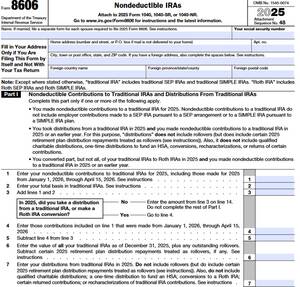
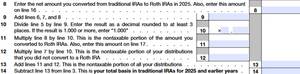
As explained, IRS Form 8606 is filed in any tax year with the IRA owner’s federal income tax return in which the IRA owner made a nondeductible traditional IRA contribution. But the IRS has stated that it will process a stand-alone Form 8606. This is the case even if Form 8606 is filed beyond the normal three-year statute of limitations for claiming a refund. A copy of Page 1 of the 2025 IRS Form 8606 is shown below. Note in particular lines 1 through 9 and use of the “pro-rata” rule as shown lines 10 through 14.
What is the Basis of An Inherited Traditional IRA?
If the deceased traditional IRA owner had basis in their traditional IRA, then the beneficiary (s) assumes that basis in the inherited traditional IRA. That said, it has to be stated that most traditional IRA beneficiaries(s) (and their tax preparers) are unaware of basis in an inherited traditional IRA. A beneficiary must determine whether the deceased individual whose traditional IRA they inherited had ever made a non-deductible IRA contribution. Failure to adequately investigate IRA basis will result in a beneficiary overpaying tax on distributions from the inherited IRA.
In summary, creating basis in a traditional IRA certainly adds a layer of complexity to the already complicated traditional IRA distribution rules. Fortunately, the “pro-rata” rule can help a traditional IRA owner or beneficiary avoid double taxation of the traditional IRA contributions. There is also tax software that helps simplify the pro-rata calculation. Traditional IRA owners are advised to track and carry forward from year-to-year their traditional IRA basis. Using IRS Form 8606 (Nondeductible IRAs) allows traditional IRAs to keep track from year-to-year of their traditional IRA basis.
With a traditional IRA owner’s proper documentation and record keeping, the after-taxed dollars used to make contributions to a non-deductible traditional IRA will not be inadvertently taxed again when they are withdrawn by the traditional IRA owner and future traditional IRA beneficiary(s). Traditional IRA owners who have traditional IRA “basis” questions are advised to consult with a tax professional.

A former career Federal employee, Ed has published a staggering 1,200+ separate articles on Federal Benefits and Retirement! Just “Google” his name, and you are likely to find a plethora of sites that contain his writings. Drawn to its mission to reach, teach and serve Feds, Serving Those Who Serve is the only financial planning practice with which Ed has chosen to affiliate in over 20 years teaching. In addition to conducting Federal Benefits seminars for Serving Those Who Serve, you can find Ed’s writings here on our blog in the FedZone, and on Fed-Soup, MyFederalRetirement, FederalNews Radio and NITP.
He is a member of the Maryland Society of Accountants, the National Association of Enrolled Agents, the International Society of Certified Employee Benefits Specialists, the Financial Planning Association, the National Association of Health Underwriters, and the Society of Financial Service Professionals. Since 1999, Ed has taught many thousands of Federal employees about their benefits, in person and at Federal agencies all over the country. Ed is a true national treasure.
Edward A. Zurndorfer is a CERTIFIED FINANCIAL PLANNER™ professional, Chartered Life Underwriter, Chartered Financial Consultant, Chartered Federal Employee Benefits Consultant, Certified Employees Benefits Specialist and IRS Enrolled Agent in Silver Spring, MD. Tax planning, Federal employee benefits, retirement and insurance consulting services offered through EZ Accounting and Financial Services, and EZ Federal Benefits Seminars, located at 833 Bromley Street – Suite A, Silver Spring, MD 20902-3019 and telephone number 301-681-1652. Raymond James is not affiliated with and does not endorse the opinions or services of Edward A. Zurndorfer or EZ Accounting and Financial Services. The information has been obtained from sources considered to be reliable, but we do not guarantee that the foregoing material is accurate or complete. While we are familiar with the tax provisions of the issues presented herein, as Financial Advisors of RJFS, we are not qualified to render advice on tax or legal matters. You should discuss tax or legal matters with the appropriate professional.
The FedLife Podcast is your in-depth, biweekly deep dive into the world of federal benefits and retirement planning. Hosted by federal benefits expert Ed Zurndorfer and Dan Sipe of Serving Those Who Serve, each 30-minute episode unpacks the complexities of FERS and CSRS retirement, FEHB and Medicare, survivor benefits, tax planning, and more. Designed for federal employees and retirees who want more than just the basics, FedLife goes beyond the headlines to explore the rules, nuances, and strategies that can make a meaningful difference in your retirement. Remember: it’s your Fed life, make it a great one.

The Fed15 Podcast is your weekly 15(ish)-minute briefing on federal benefits and financial planning, built specifically for federal employees and retirees. Hosted by Dan Sipe and Katelyn Murray of Serving Those Who Serve, each episode delivers clear, actionable guidance on topics like FERS and CSRS retirement, TSP strategies, FEHB, survivor benefits, tax planning, and more! Whether you’re five years from retirement or already there, The Fed15 helps you cut through the noise, avoid costly mistakes, and make confident decisions about your federal benefits.