















In Part 1 of our five-week series on the TSP funds, we explored the G Fund and discussed why it occupies a unique place in the investment world. Because the G Fund’s underlying securities aren’t publicly traded, it offers a level of stability that can’t be found in traditional bond funds; however, it also carries significant purchasing power risk, which can be a concern for Feds looking to leverage capital appreciation to build a long-term retirement fund.
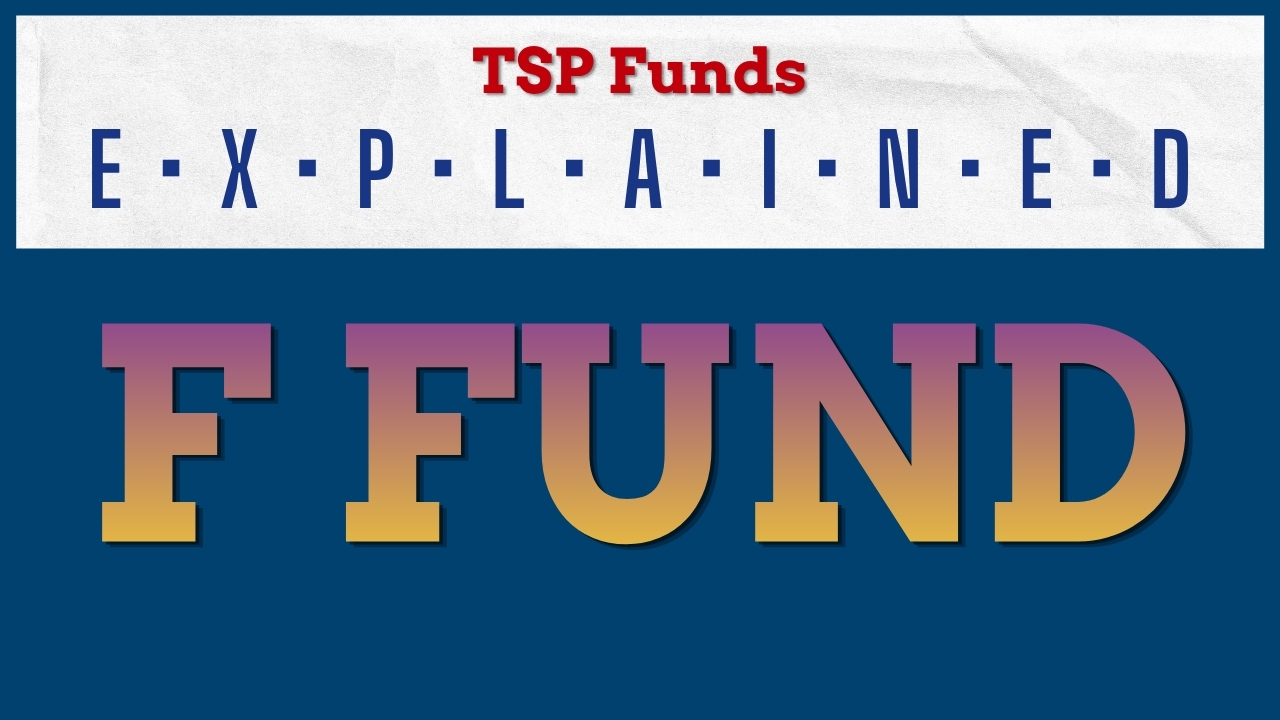
This week, we’re looking at the G Fund’s closest cousin: the Fixed Income Index Investment (F) Fund.
At first glance, both the G and F Funds invest in fixed-income securities. But that’s where many of the similarities end. The F Fund behaves very differently than the G Fund, and understanding those differences is essential.
What Is the F Fund?
The F Fund is designed to track the performance of the Bloomberg U.S. Aggregate Bond Index, one of the most widely recognized benchmarks for the U.S. bond market.
Rather than investing in a single type of bond, this index includes thousands of investment-grade fixed-income securities issued throughout the United States, including: U.S. Treasury securities, government agency bonds, mortgage-backed securities, corporate bonds, and other investment-grade debt issued by U.S. borrowers.
Think of the F Fund as providing broad exposure to the U.S. bond market, much like the C Fund provides broad exposure to large U.S. companies.
Unlike the G Fund, the F Fund Trades in the Market
One of the biggest differences between the G Fund and the F Fund is that the bonds held by the F Fund are publicly traded. This means investors buy and sell these securities every day, and their prices fluctuate based on supply and demand, interest rates, inflation expectations, and broader economic conditions.
As a result, the value of the F Fund can rise… and fall.
This surprises some federal employees because bonds are often thought of as “safe” investments. While bonds have historically been less volatile than stocks, it’s important to acknowledge that they are still subject to market risk.
Why Do Bond Prices Change?
To answer that question, we need to examine the nature of bonds. A bond is essentially a loan. When you buy a bond, you are lending money to a government or company in exchange for 1) periodic interest payments and 2) the return of your principal when the bond matures.
So why does the value of an existing bond change over time? The primary reason is interest rates.
Imagine you own a bond paying 2% interest. If newly issued bonds begin paying 5%, investors are unlikely to pay full price for your older, lower-yielding bond. As a result, your bond’s market value typically falls until its yield becomes competitive with newer bonds.
The opposite can also happen. If interest rates decline, existing bonds with higher interest rates often become more valuable.
Because the F Fund owns thousands of bonds with varying maturities, these price movements are reflected in the fund’s daily value.
A Real-World Example: 2022
For many years, investors viewed bonds as a relatively stable portion of a diversified portfolio.
Then came 2022…
As inflation reached levels not seen in decades, the Federal Reserve aggressively increased interest rates in an effort to slow the economy and bring inflation under control. Those rapid rate increases caused bond prices to decline sharply, and the F Fund experienced one of the largest annual losses in its history. This coincided with a ~20% pullback in equity markets, creating a very rare market condition called a “double bear market,” an event that has only happened roughly three times in the past 150 years.
For many investors, 2022 was an important reminder that bonds carry risks of their own. While they may generally fluctuate less than stocks over long periods, they are not totally immune to market declines.
Does That Mean the F Fund Is a Bad Investment?
Not at all! Every investment comes with tradeoffs.
Stocks have historically offered greater long-term growth potential, but they also tend to experience larger swings in value.
Bonds have generally produced lower long-term returns, but they have often provided lower volatility and income generation. For many investors, that combination can and should play an important role in managing overall portfolio risk.
The key is understanding that the F Fund is designed to serve a different purpose than the stock funds within the TSP.
Rather than asking whether the F Fund is “good” or “bad,” it’s more helpful to ask what role it may play within an overall retirement strategy.
How Does the F Fund Compare to the G Fund?
Because both funds invest in fixed-income securities, they’re often compared with one another. However, they solve different problems:
Historically, the F Fund has offered the potential for higher returns than the G Fund during some periods, but it also introduces additional market risk. Neither fund is inherently superior. They simply provide different types of exposure within a diversified investment portfolio.
The F Fund offers federal employees diversified exposure to the U.S. bond market through thousands of investment-grade fixed-income securities. While bonds have historically experienced less volatility than stocks, it’s important to remember that they are still subject to changes in interest rates and market conditions.
Understanding how the F Fund works and how it differs from the other fund options in the TSP is an important step toward making informed decisions about your investment strategy as a Fed.
That said, there is no one-size-fits-all allocation. The appropriate mix of investments depends on your retirement timeline, financial goals, risk tolerance, pension, other assets, and overall financial plan. For that reason, we can’t recommend a specific TSP allocation in a general article.
If you’d like personalized guidance, the team at Serving Those Who Serve is here to help. Email [email protected] to schedule your complimentary federal benefits review. We’ll help you understand how your TSP fits into your broader retirement strategy and discuss an investment allocation that’s appropriate for your unique goals and circumstances.
Next week in our series, we’ll turn our attention to one of the TSP’s most popular investment options: the C Fund, which tracks the S&P 500 and invests in many of America’s largest publicly traded companies.
**Written by Katelyn Murray, CFP®, ChFEBC®, FBS®, CFT-1™, ECA. The information has been obtained from sources considered reliable but we do not guarantee that the foregoing material is accurate or complete. Any opinions are those of Katelyn Murray and not necessarily those of RJFS or Raymond James. Any information is not a complete summary or statement of all available data necessary for making an investment decision and does not constitute a recommendation. Investing involves risk and you may incur a profit or loss regardless of strategy suggested. Every investor’s situation is unique and you should consider your investment goals, risk tolerance, and time horizon before making any investment or financial decision. Prior to making an investment decision, please consult with your financial advisor about your individual situation. While we are familiar with the tax provisions of the issues presented herein, as Financial Advisors of RJFS, we are not qualified to render advice on tax or legal matters. You should discuss tax or legal matters with the appropriate professional. **
The FedLife Podcast is your in-depth, biweekly deep dive into the world of federal benefits and retirement planning. Hosted by federal benefits expert Ed Zurndorfer and Dan Sipe of Serving Those Who Serve, each 30-minute episode unpacks the complexities of FERS and CSRS retirement, FEHB and Medicare, survivor benefits, tax planning, and more. Designed for federal employees and retirees who want more than just the basics, FedLife goes beyond the headlines to explore the rules, nuances, and strategies that can make a meaningful difference in your retirement. Remember: it’s your Fed life, make it a great one.

The Fed15 Podcast is your weekly 15(ish)-minute briefing on federal benefits and financial planning, built specifically for federal employees and retirees. Hosted by Dan Sipe and Katelyn Murray of Serving Those Who Serve, each episode delivers clear, actionable guidance on topics like FERS and CSRS retirement, TSP strategies, FEHB, survivor benefits, tax planning, and more! Whether you’re five years from retirement or already there, The Fed15 helps you cut through the noise, avoid costly mistakes, and make confident decisions about your federal benefits.