















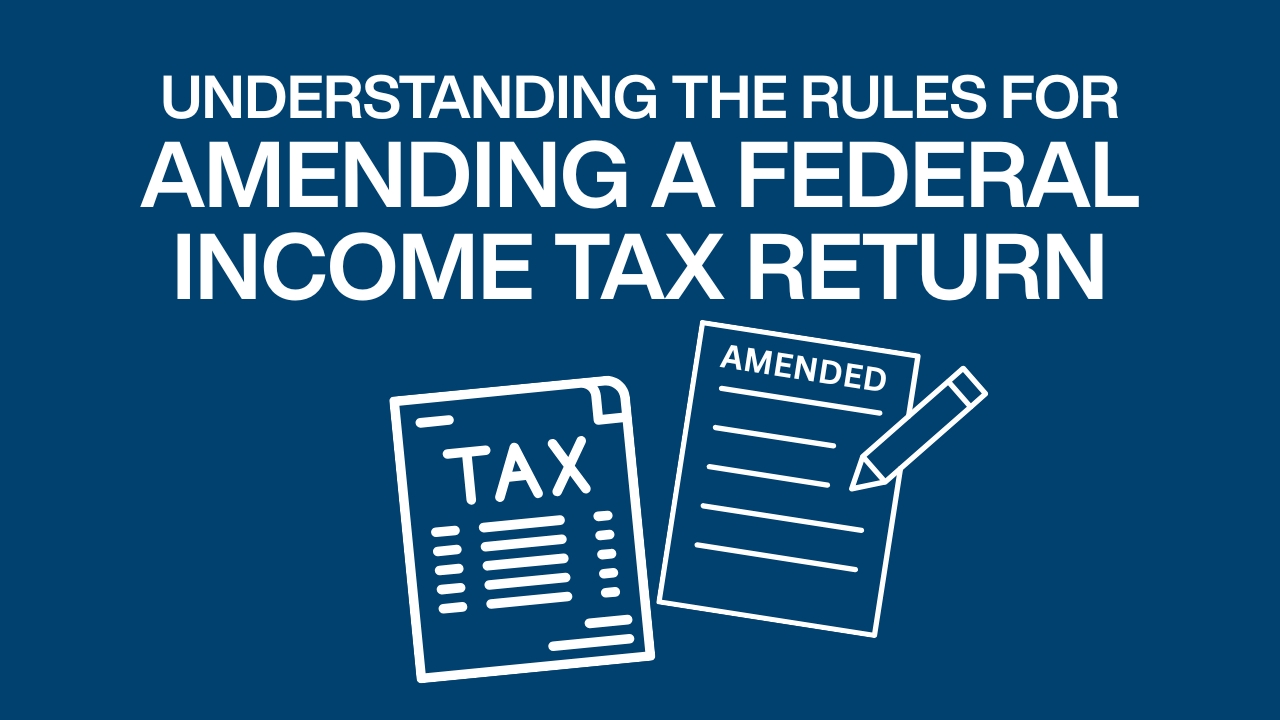

Individuals who found errors on their 2025 federal income tax returns (or prior year returns, see below) that they recently filed earlier this year can file an amended federal income tax return. Each year millions of individuals file amended tax returns to correct errors or omissions on their originally filed federal income tax returns. IRS Form 1040-X (Amended U.S. Individual Income Tax Return) is used to amend a federal income tax return. A portion of IRS Form 1040-X is presented here:
Some of the most common reasons to amend a federal income tax return are if there is a change in an individual’s: (1) Filing status: (2) Income; (3) Deductions; (4) Tax credits; (5) Dependents; and (6)Tax liability. A federal amended tax return does not have to be filed if the IRS notifies the individual (via written correspondence) that the IRS corrected errors on the originally filed tax return.
The following is important information and rules that individuals who plan to amend their 2025 or earlier year federal income tax return should note:
However, there is no statute of limitation when amending a prior year federal income tax return which results in a balance due.
Note that the direct deposit option is available only for electronically filed amended tax returns. In case an amended tax return shows a balance due rather than a refund, the IRS offers a range of options of electronic payments on how to pay, including direct payment from a bank or credit union checking or savings or savings account, a credit card and a debit card.
The IRS also accepts full or partial payments, including a payment plan. However, individuals should be warned that penalties and interest will continue to accrue interest charges until the full balance due is paid.
On the other hand, if the individual receiving the correspondence disagrees, the individual can handle that situation by responding to the IRS correspondence. According to the IRS, an amended tax return is the equivalent to correspondence. Most importantly, responding to a notice is normally faster and simpler than filing an amended tax return.
Another word of caution for individuals receiving IRS correspondence: The IRS will always communicate with an individual via US mail. Any individuals receiving emails or telephone calls from someone purporting to be from the IRS are likely going to be the victim of a scam.
Besides an individual receiving IRS correspondence via US mail concerning mathematical errors on an originally filed tax return and therefore not filing an amended tax return, there are other reasons an individual should not file an amended tax return. To determine whether amending a federal income tax return is necessary, individuals are encouraged to go to the IRS website: https://www.irs.gov/help/ita/should-i-file-an-amended-return and use the IRS tax tool Should I File an Amended Return?
Individuals contemplating filing an amended tax return should also be sure to read the Form 1040-X instructions. For more complicated tax issues that may require the filing of an amended tax return, individuals are advised to consult with a tax professional.
Edward A. Zurndorfer is a CERTIFIED FINANCIAL PLANNER™ professional, Chartered Life Underwriter, Chartered Financial Consultant, Chartered Federal Employee Benefits Consultant, Certified Employees Benefits Specialist and IRS Enrolled Agent in Silver Spring, MD. Tax planning, Federal employee benefits, retirement and insurance consulting services offered through EZ Accounting and Financial Services, and EZ Federal Benefits Seminars, located at 833 Bromley Street – Suite A, Silver Spring, MD 20902-3019 and telephone number 301-681-1652. Raymond James is not affiliated with and does not endorse the opinions or services of Edward A. Zurndorfer or EZ Accounting and Financial Services. The information has been obtained from sources considered to be reliable, but we do not guarantee that the foregoing material is accurate or complete. While we are familiar with the tax provisions of the issues presented herein, as Financial Advisors of RJFS, we are not qualified to render advice on tax or legal matters. You should discuss tax or legal matters with the appropriate professional.
The FedLife Podcast is your in-depth, biweekly deep dive into the world of federal benefits and retirement planning. Hosted by federal benefits expert Ed Zurndorfer and Dan Sipe of Serving Those Who Serve, each 30-minute episode unpacks the complexities of FERS and CSRS retirement, FEHB and Medicare, survivor benefits, tax planning, and more. Designed for federal employees and retirees who want more than just the basics, FedLife goes beyond the headlines to explore the rules, nuances, and strategies that can make a meaningful difference in your retirement. Remember: it’s your Fed life, make it a great one.

The Fed15 Podcast is your weekly 15(ish)-minute briefing on federal benefits and financial planning, built specifically for federal employees and retirees. Hosted by Dan Sipe and Katelyn Murray of Serving Those Who Serve, each episode delivers clear, actionable guidance on topics like FERS and CSRS retirement, TSP strategies, FEHB, survivor benefits, tax planning, and more! Whether you’re five years from retirement or already there, The Fed15 helps you cut through the noise, avoid costly mistakes, and make confident decisions about your federal benefits.