

















This is the third of four FEDZONE columns discussing the withdrawal options that are available to separated Thrift Savings Plan TSP) participants. In these columns, a “separated” participant means a civilian employee or a member of the uniformed services who has separated from that employment.
Retirement account rollovers are an important part of a federal employee’s retirement savings management. Whether an employee is changing jobs – leaving federal service and working in private industry – or transitioning into retirement, an employee’s understanding of how rollovers work can help the employee make informed decisions about their financial future.
What is a rollover?
A rollover is the process of transferring funds from one retirement account to another. There are two ways for a federal employee or retiree to perform TSP rollovers, namely: (1) Direct (“trustee-to-trustee”); or (2) Indirect.
Using a direct rollover ensures that a TSP participant’s TSP account will be moved directly to a qualified retirement account (such as a 401(k) qualified retirement plan), or to an IRA. Direct rollovers also help avoid any tax penalties or missed deadlines.
With an indirect TSP rollover, the TSP participant receives a check or distribution which must be deposited into another qualified retirement account or IRA within 60 days to avoid taxes and penalties.
TSP distributions considered as eligible rollover distributions.
The following TSP distributions are considered “eligible” rollover distributions:
How is a TSP direct rollover made?
The TSP makes direct rollovers daily by the issuance of a US Treasury check made out to the destination qualified retirement or IRA. The Employer Identification Number of the TSP is 52-1529691. A TSP participant’s financial institution or retirement plan administrator (to which the TSP directly rolls over the TSP funds on behalf of the TSP participant) must certify that the financial institution or retirement plan administrator will accept the TSP funds and provide rollover information on the TSP participant’s distribution request.
Before a TSP participant decides to directly rollover money from his or her TSP accounts to an IRA or to an eligible employer retirement plan, the TSP participant should find out whether: (1) The participant’s IRA or employer-sponsored qualified retirement plan accepts direct rollovers; (2) The minimum amount the IRA or employer will accept; and (3) Whether any tax-exempt or Roth IRA contributions will be accepted.
TSP participants should be aware that the rules for eligible employer-sponsored qualified retirement plans that receive the direct rollover will determine the TSP participant’s investment options, fees and rights to payment.
The type of retirement plan or account to which a TSP participant can rollover his or her TSP funds depends on whether the funds are from the traditional TSP balance or the Roth TSP balance.
Eligible traditional TSP rollover distributions may be directly rolled over to a traditional IRA or to a traditional eligible employer-sponsored retirement plan.
Eligible Roth TSP rollover distributions may be rolled over to a Roth IRA or to a Roth eligible Roth employer-sponsored retirement plan.
The following items cannot be rolled over:
Requesting TSP rollovers
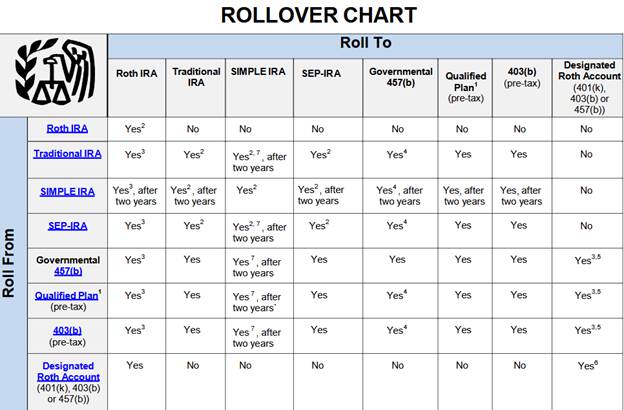
TSP participants who want to perform TSP direct rollover should request a direct rollover in MyAccount or by using one of the ThriftLine options . They should not use forms provided by the new qualified retirement, financial institution or IRA custodian. The following is a copy of the IRS “rollover chart.”
If you’ve recently left your job or are retiring, you may be wondering what to do with your old retirement plan. It’s a common question – and one with several valid answers. This outlines the four most common options available to you, with an explanation of each option’s potential benefits and limitations. Choosing the right path depends on your personal financial goals, timeline, and retirement plan.
OPTION 1: Leave the Money in Your Former Employer’s Plan, if permitted by the plan
Pros:
OPTION 2: Roll Over to a New Employer’s Plan, if available and permitted
Pros:
OPTION 3: Roll Over to an IRA
Pros:
OPTION 4: Cash Out the Account
Pros:
This guide is intended to help you understand the most common retirement plan options. However, the right choice depends on your unique financial picture.
Before acting, be sure to consider:
Edward A. Zurndorfer is a CERTIFIED FINANCIAL PLANNER™ professional, Chartered Life Underwriter, Chartered Financial Consultant, Chartered Federal Employee Benefits Consultant, Certified Employees Benefits Specialist and IRS Enrolled Agent in Silver Spring, MD. Tax planning, Federal employee benefits, retirement and insurance consulting services offered through EZ Accounting and Financial Services, and EZ Federal Benefits Seminars, located at 833 Bromley Street – Suite A, Silver Spring, MD 20902-3019 and telephone number 301-681-1652. Raymond James is not affiliated with and does not endorse the opinions or services of Edward A. Zurndorfer or EZ Accounting and Financial Services. The information has been obtained from sources considered to be reliable, but we do not guarantee that the foregoing material is accurate or complete. While we are familiar with the tax provisions of the issues presented herein, as Financial Advisors of RJFS, we are not qualified to render advice on tax or legal matters. You should discuss tax or legal matters with the appropriate professional.

A former career Federal employee, Ed has published a staggering 1,200+ separate articles on Federal Benefits and Retirement!
Just “Google” his name, and you are likely to find a plethora of sites that contain his writings. Drawn to its mission to reach, teach
and serve Feds, Serving Those Who Serve is the only financial planning practice with which Ed has chosen to affiliate in over
20 years teaching. In addition to conducting Federal Benefits seminars for Serving Those Who Serve, you can find Ed’s
writings here on our blog in the FedZone, and on Fed-Soup, MyFederalRetirement, FederalNews Radio and NITP.
He is a member of the Maryland Society of Accountants, the National Association of Enrolled Agents, the International Society of Certified Employee Benefits Specialists, the Financial Planning Association, the National Association of Health Underwriters,
and the Society of Financial Service Professionals. Since 1999, Ed has taught many thousands of Federal employees about
their benefits, in person and at Federal agencies all over the country. Ed is a true national treasure.
Edward A. Zurndorfer is a CERTIFIED FINANCIAL PLANNER™ professional, Chartered Life Underwriter, Chartered Financial Consultant, Chartered Federal Employee Benefits Consultant, Certified Employees Benefits Specialist and IRS Enrolled Agent in Silver Spring, MD. Tax planning, Federal employee benefits, retirement and insurance consulting services offered through EZ Accounting and Financial Services, and EZ Federal Benefits Seminars, located at 833 Bromley Street – Suite A, Silver Spring, MD 20902-3019 and telephone number 301-681-1652. Raymond James is not affiliated with and does not endorse the opinions or services of Edward A. Zurndorfer or EZ Accounting and Financial Services. The information has been obtained from sources considered to be reliable, but we do not guarantee that the foregoing material is accurate or complete. While we are familiar with the tax provisions of the issues presented herein, as Financial Advisors of RJFS, we are not qualified to render advice on tax or legal matters. You should discuss tax or legal matters with the appropriate professional.
The FedLife Podcast is your in-depth, biweekly deep dive into the world of federal benefits and retirement planning. Hosted by federal benefits expert Ed Zurndorfer and Dan Sipe of Serving Those Who Serve, each 30-minute episode unpacks the complexities of FERS and CSRS retirement, FEHB and Medicare, survivor benefits, tax planning, and more. Designed for federal employees and retirees who want more than just the basics, FedLife goes beyond the headlines to explore the rules, nuances, and strategies that can make a meaningful difference in your retirement. Remember: it’s your Fed life, make it a great one.

The Fed15 Podcast is your weekly 15(ish)-minute briefing on federal benefits and financial planning, built specifically for federal employees and retirees. Hosted by Dan Sipe and Katelyn Murray of Serving Those Who Serve, each episode delivers clear, actionable guidance on topics like FERS and CSRS retirement, TSP strategies, FEHB, survivor benefits, tax planning, and more! Whether you’re five years from retirement or already there, The Fed15 helps you cut through the noise, avoid costly mistakes, and make confident decisions about your federal benefits.