

















Tax season is now in full swing. This article breaks down the federal taxation of federal government pensions – both FERS and CSRS.

Edward A. Zurndorfer
Both a CSRS/CSRS Offset and FERS employees make nondeductible contributions to their respective retirement systems. Each pay period, an employee contributes to his or her retirement system via payroll deduction. A portion of the employee’s after-tax salary is contributed. The following table summarizes how much an employee contributes on an after-tax basis:
| Retirement System | Percentage of After-Taxed Salary Contribution |
| CSRS | 7.0% |
| CSRS Offset | 0.8% |
| FERS (hired before 1/1/2013) | 0.8% |
| FERS-RAE (hired during 2013) | 3.1% |
| FERS-FRAE (hired after 12/31/2013) | 4.4% |
CSRS/CSRS Offset and FERS employees who retire on a non-disability retirement go by the following rules with respect to how much of their CSRS or FERS annuity is federally taxed:
First, some important terms related to employees once they have retired from federal service:
Any employee who retires after November 18,1996 and whose annuity’s starting date is November 19,1996 or later, must use the IRS Simplified Method to calculate the tax-free portion of their CSRS or FERS annuity. The following presents the Simplified Method Worksheet for calculating the taxable amount of CSRS or FERS annuity payments.

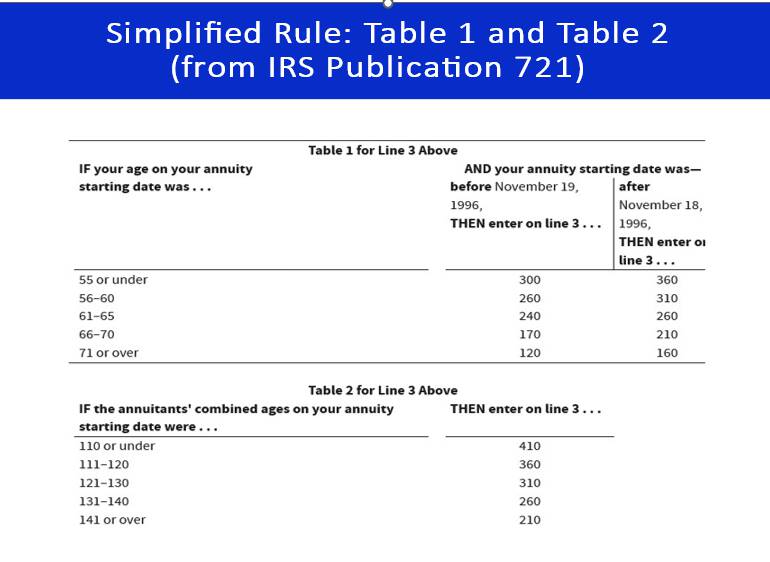
Note the following from the Simplified Method Worksheet:
The following example illustrates the Simplified Rule for calculating the taxable portion of a FERS annuity.
Donald, a FERS-covered employee, retired from federal service on November 30, 2021 under an annuity that provides a full 50 percent survivor benefit to his wife, Kathy. Donald’s first annuity check was dated January 1, 2022. Donald uses the Simplified Rule to determine the tax-free portion of his FERS annuity that he received during 2022.
Donald’s monthly FERS gross annuity is $3,000 for a total of 12 months times $3,000 per month or $43,000 during all of 2022. Donald has contributed a total of $52,000 of his after-taxed salary to the FERS Retirement and Disability Fund while in federal service. During 2022, Donald was 56 years old, and Kathy was 54 years old when Donald received his first FERS annuity check.
Donald’s completed worksheet is shown below. To complete line 3 of the worksheet Donald used Table 2 and found the number in the second column opposite the age range that includes 110 (his age during 2022 of 56 plus Kathy’s age of 54 during 2022 which equals 110). Donald keeps a copy of the complete worksheet for his records. It will help him and Kathy to determine the taxable amount of the survivor annuity in the event Donald predeceases Kathy.
Note the following from Donald’s Simplified Rule worksheet:
The FedLife Podcast is your in-depth, biweekly deep dive into the world of federal benefits and retirement planning. Hosted by federal benefits expert Ed Zurndorfer and Dan Sipe of Serving Those Who Serve, each 30-minute episode unpacks the complexities of FERS and CSRS retirement, FEHB and Medicare, survivor benefits, tax planning, and more. Designed for federal employees and retirees who want more than just the basics, FedLife goes beyond the headlines to explore the rules, nuances, and strategies that can make a meaningful difference in your retirement. Remember: it’s your Fed life, make it a great one.

The Fed15 Podcast is your weekly 15(ish)-minute briefing on federal benefits and financial planning, built specifically for federal employees and retirees. Hosted by Dan Sipe and Katelyn Murray of Serving Those Who Serve, each episode delivers clear, actionable guidance on topics like FERS and CSRS retirement, TSP strategies, FEHB, survivor benefits, tax planning, and more! Whether you’re five years from retirement or already there, The Fed15 helps you cut through the noise, avoid costly mistakes, and make confident decisions about your federal benefits.