















The Thrift Savings Plan (TSP) offers federal employees and members of the uniformed services a straightforward lineup of investment options, but understanding what each fund actually does—and when it makes sense to use it—is essential to building a retirement strategy. While the TSP includes Lifecycle (L) Funds that provide inherent diversification that automatically scales risk down over time, these funds are not different choices, but are rather built from the five core investment options: the G, F, C, S, and I Funds.
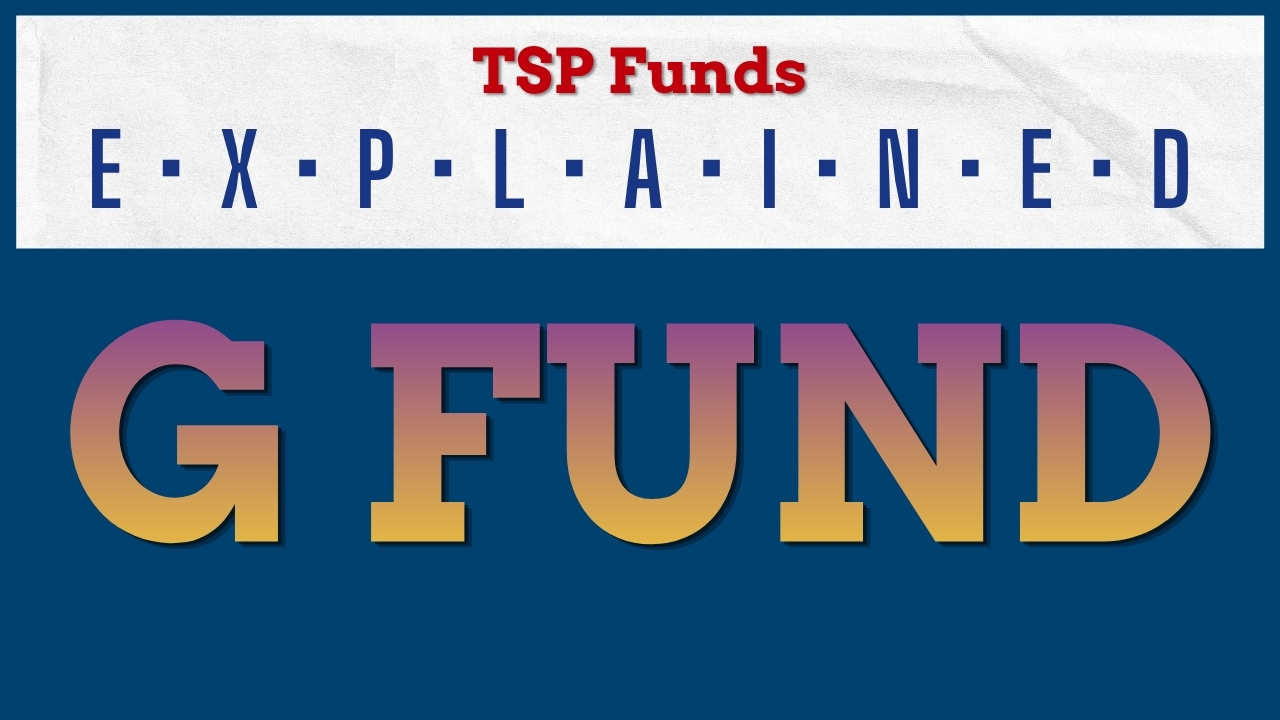
Over the next five weeks, we’ll take an in-depth look at each of these core funds, examining which types of securities each fund invests in, how they have historically performed, the risks and potential rewards they offer, and the role they can play in a diversified retirement portfolio. We’ll begin with the Government Securities Investment (G) Fund, the TSP’s most conservative investment option and one that is often misunderstood by participants.
Unlike stock funds or traditional bond funds, the G Fund is designed to preserve principal while earning interest. That combination makes it unique not only within the TSP, but across the larger investment landscape.
But does “safe” mean “risk-free?” Not exactly.
Understanding how the G Fund works, and what risks it does and does not protect against, is an important part of making informed decisions about your TSP investment strategy.
What Is the G Fund?
The G Fund invests exclusively in special U.S. Treasury securities created specifically for the Thrift Savings Plan.
These securities are different from the Treasury bills, notes, and bonds you can buy through a brokerage account or TreasuryDirect. These are non-marketable securities, meaning they are not bought and sold on the public market. Instead, they are issued directly by the U.S. Treasury for the exclusive use of the TSP. Similar special securities are also used to support the Social Security Trust Fund.
Because these securities don’t trade in financial markets, the G Fund avoids one of the biggest risks faced by most bond investments: fluctuations in market price.
One of the defining characteristics of the G Fund is that its share price doesn’t move up and down each day. Since the underlying securities are not publicly traded, their value isn’t affected by changes in investor sentiment, interest rates, or stock market volatility in the same way publicly traded investments are.
That means your balance in the G Fund won’t decline because of a bad day (or even a bad year, for that matter) in the financial markets.
For federal employees who are looking for stability, particularly those nearing retirement or already retired, this characteristic of the G Fund can be especially appealing.
The Most Common Misconception About the G Fund
Because of the lack of market fluctuation described above, you’ll often hear people say, “The G Fund can’t lose money.”
That statement deserves more than a little clarification.
While it’s true that the G Fund has historically protected investors from market losses and your balance there won’t decline simply because the stock market falls or interest rates rise, protecting your account balance isn’t the same thing as protecting your purchasing power.
From a financial planning perspective, it’s important to recognize that there are different types of investment risk. Market risk is only one of them (albeit, the most prominent one in most investors’ minds). Inflation risk, the possibility that rising prices erode the value of your savings over time, is another.
Imagine your G Fund balance earns 2% in a year, but inflation is running at 4% (this shouldn’t be particularly hard to do on the heels of the 9.1% inflation rate we hit in June 2022). Even though your account balance increased, your money now actually buys you less than it did the year before.
The same concept applies when examining how taxes impact pre-tax balances in the G Fund when they are distributed in retirement. For those curious about that topic, we have a full article available for further reading.
In short, it’s more accurate to say the G Fund protects against market volatility, but not necessarily against the long-term effects of inflation (or taxes in the case of pre-tax balances).
When Might the G Fund Make Sense?
Let me say upfront: Every federal employee’s financial situation is different, so there is no universally “correct” amount to invest in the G Fund.
That said, many investors appreciate the G Fund because it offers preservation of principal, no day-to-day volatility, and interest backed by the U.S. Treasury.
For someone approaching retirement, reducing exposure to market swings may become a higher priority than maximizing long-term growth. On the other hand, a younger employee with decades until retirement may have dramatically different objectives, and as such, may want to limit their G Fund exposure in favor of asset classes with higher growth potential.
Neither approach is inherently right or wrong. The appropriate allocation depends on your personal financial goals, retirement timeline, income needs, risk tolerance, and overall investment strategy.
The G Fund Is Only One Piece of the Puzzle
One of the greatest strengths of the TSP is that it offers multiple asset classes that can work together to provide diversification within a retirement portfolio.
While the G Fund focuses on capital preservation, the other core TSP funds provide exposure to bonds, large U.S. companies, smaller U.S. companies, and international markets. Each serves a different role and carries its own risks and potential rewards.
The key isn’t determining whether the G Fund is “good” or “bad.” The more important question is how it fits into your overall retirement plan. And that is a question that can’t be answered in a general article because no two federal employees have identical financial goals and contexts!
Truthfully, the G Fund is one of the most unique investment options available inside or outside of the TSP. Its combination of principal preservation and Treasury-backed interest makes it unlike traditional bond funds or savings accounts.
At the same time, it’s important to understand what the G Fund is designed to do and what it isn’t. While it can help reduce market risk, it may not keep pace with inflation over long periods, meaning purchasing power remains an important consideration when planning for retirement.
Your ideal investment strategy should be based on a comprehensive review of your retirement goals, pension, TSP balance, Social Security benefits, risk tolerance, and overall financial picture.
If you’d like help determining how your TSP fits into your broader federal retirement strategy, the team at Serving Those Who Serve is here to help. Email [email protected] to schedule your complimentary federal benefits review. We’ll help you understand your federal benefits, evaluate your retirement strategy, and determine an investment allocation that’s appropriate for your unique financial goals and circumstances.
And be sure to stay tuned for Part 2 of our series next week, as we explore the F Fund!
**Written by Katelyn Murray, CFP®, ChFEBC®, FBS®, CFT-1™, ECA. The information has been obtained from sources considered reliable but we do not guarantee that the foregoing material is accurate or complete. Any opinions are those of Katelyn Murray and not necessarily those of RJFS or Raymond James. Any information is not a complete summary or statement of all available data necessary for making an investment decision and does not constitute a recommendation. Investing involves risk and you may incur a profit or loss regardless of strategy suggested. Every investor’s situation is unique and you should consider your investment goals, risk tolerance, and time horizon before making any investment or financial decision. Prior to making an investment decision, please consult with your financial advisor about your individual situation. While we are familiar with the tax provisions of the issues presented herein, as Financial Advisors of RJFS, we are not qualified to render advice on tax or legal matters. You should discuss tax or legal matters with the appropriate professional. **
The FedLife Podcast is your in-depth, biweekly deep dive into the world of federal benefits and retirement planning. Hosted by federal benefits expert Ed Zurndorfer and Dan Sipe of Serving Those Who Serve, each 30-minute episode unpacks the complexities of FERS and CSRS retirement, FEHB and Medicare, survivor benefits, tax planning, and more. Designed for federal employees and retirees who want more than just the basics, FedLife goes beyond the headlines to explore the rules, nuances, and strategies that can make a meaningful difference in your retirement. Remember: it’s your Fed life, make it a great one.
The Fed15 Podcast is your weekly 15(ish)-minute briefing on federal benefits and financial planning, built specifically for federal employees and retirees. Hosted by Dan Sipe and Katelyn Murray of Serving Those Who Serve, each episode delivers clear, actionable guidance on topics like FERS and CSRS retirement, TSP strategies, FEHB, survivor benefits, tax planning, and more! Whether you’re five years from retirement or already there, The Fed15 helps you cut through the noise, avoid costly mistakes, and make confident decisions about your federal benefits.