

















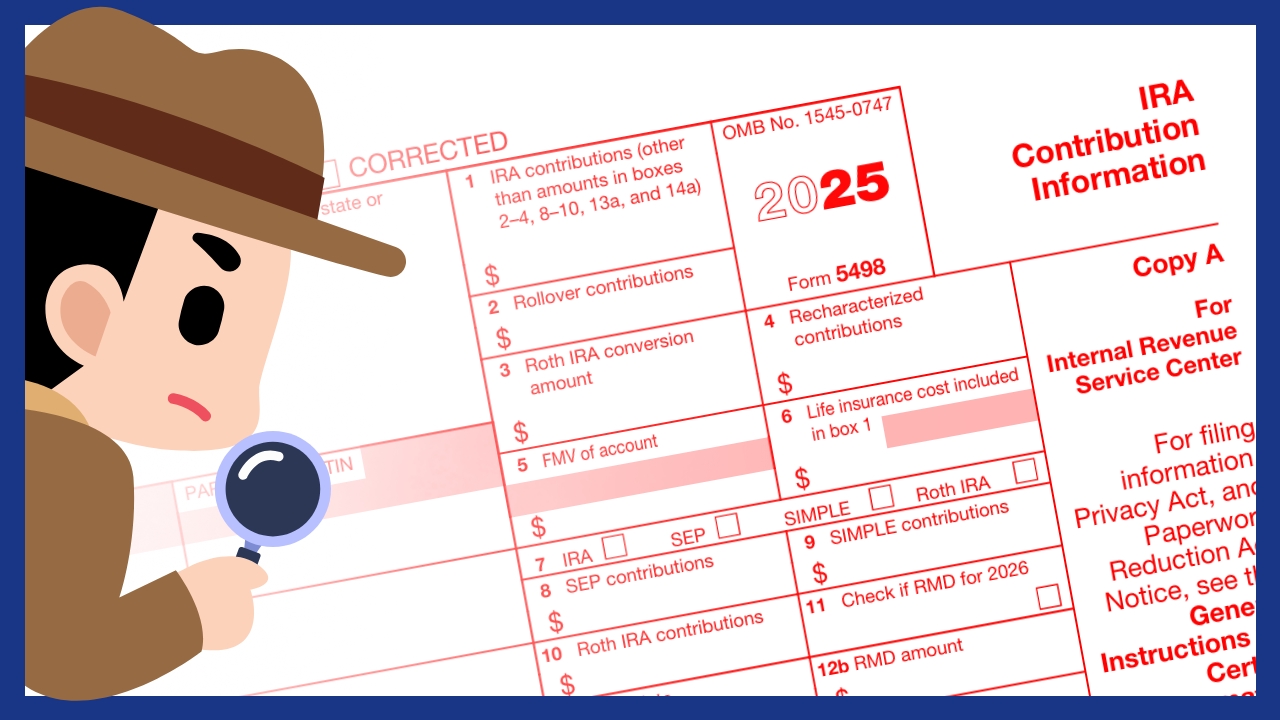

IRS Form 5498 (IRA Contribution Information) is vitally important for individuals who own any type of Individual Retirement Arrangement (IRA). The Form 5498 is completed by every IRA custodian meaning that any individual who owns multiple IRAs will likely receive more than one Form 5498.
Form 5498 is an informational reporting form and not filed with an IRA owner’s federal income tax return. The form is provided to both the IRA owner and to the IRS. IRA custodians have until May 31 (about six weeks after the April 15 filing deadline) to release the form. IRA owners can expect to receive their 2025 Form 5498 by May 31, 2026.
Many federal employees and retirees own different types of IRAs including contributory traditional IRAs and Roth IRAs, rollover traditional IRAs and rollover Roth IRAs, and converted Roth IRAs. Some may also own SEP IRAs and SIMPLE IRAs. To help these employees and retirees understand Form 5498, this column explains some of the important details reported on the form.
The following is a copy of the 2025 Form 5498:

The following presents a brief discussion and explanation of the information shown in the various boxes of IRS Form 5498:
Example 1. Joan made a $7,000 traditional IRA contribution in February 2026. She specified to her custodian that her IRA contribution is for 2025.In late May 2026, Joan will receive a 2025 Form 5498 from her IRA custodian showing a $7,000 traditional IRA contribution for calendar year 2025.
Example 2. Phillip made a $7,000 traditional IRA contribution in March 2026. He specified to his IRA custodian that his IRA contribution is for 2026, not for 2025. In late May 2027, Phillip will receive a 2026 Form 5498 from his IRS custodian showing a $7,000 traditional IRA for calendar year 2026.
Note that Box 1 of Form 5498 does not specify whether the traditional IRA contribution is deductible or not deductible. It only shows that a traditional IRA contribution was made. To report a nondeductible traditional IRA contribution, the traditional IRA owner must report the contribution on IRS Form 8606 (Nondeductible IRA) as part of that year’s federal income tax return. A deductible traditional IRA contribution will appear on the traditional IRA owner’s federal income tax return as an adjustment to income.
Example 3. Richard took a $300,000 distribution from his traditional TSP in October 2025. He used the funds to make a downpayment on a new house. This withdrawal generated a 2025 1099-R. In November 2025, Richard sold his own home and uses the sale proceeds to roll $300,000 into his traditional IRA. This was within 60 days of the TSP distribution in October 2025. This rollover will generate a 2025 Form 5498 showing the $300,000 rollover in Box 2. Richard will report on his 2025 federal income tax return that the $300,000 was rolled and should not be taxable. The IRS will receive sometime in late May 2026 Form 5498 showing Richard’s nontaxable $300,000 rollover contribution.
Example 4. Sharon, age 45 and a federal employee, performed her first Roth IRA conversion in 2025 for $25,000. Sharon had not previously made any contributions to a Roth IRA. The $25,000 Roth IRA conversion generated a 1099-R showing the $25,000 distribution from Sharon’s traditional IRA. The conversion also produced a 2025 Form 5498 which reported $25,000 in Box 3. Any of Sharon’s Roth IRA conversions performed during 2025 receive a January 1,2025 starting date for the purpose of the “five-year” rule. Based on her 2025 Form 5498, Sharon knows she will have full access to the $25,000 of converted Roth IRA dollars, both tax- and penalty-free as of January 1, 2030. Sharon will have to wait until she is 59.5 in 2039 in order to withdraw income tax-free any of the earnings on her 2025 Roth IRA conversion.
If Sharon performs any more Roth IRA conversions in future years, then she will receive another Form 5498 in the year of each conversion. Sharon will know the precise amount of all her Roth IRA conversions, and when these specific conversion dollars are available income tax- and penalty-free by referring to the annual Form 5498 forms.
Example 5. Carlos, age 43, made his first Roth IRA contribution in 2008 in the amount of $2,000. Carlos received a 2008 Form 5498 from his IRA contribution indicating in Box 10 his Roth IRA contribution of $2,000. The $2,000 Roth IRA contribution was Carlos’ first Roth IRA contribution and also locks in his Roth IRA starting date for the “five-year forever” clock as of January 1, 2008. Carlos subsequently contributed $5,000 a year to his Roth IRA for the next 17 years (2009 – 2025) a total of $85,000. Carlos’ custodian continues to send Carlos and the IRS a new Form 5498 each year. In 2026, Carlos’ total Roth IRA balance is $175,000. Carlos needs cash to cover an emergency expense. By totaling the amounts in Box 10 of Form 5498 for all the years he contributed to his Roth IRA, Carlos determines that he has access to $87,000 ($2,000 plus $85,00) that is free-and-clear of any taxes or early withdrawal penalties. Note that a Roth IRA owner always has access to his or Roth IRA contributions, no matter the Roth IRA owner’s age. That means the Roth IRA owner can withdraw some or all of the Roth IRA contributions with no income tax consequences.
Traditional IRA owners should be aware that the amount shown in Box 12b may not be accurate for the following reasons: (1) Use of the wrong life expectancy table; (2) There may have been an outstanding rollover at the end of the year; and (3) Box 12b is indicative of the RMD for only the traditional IRA held with that IRA custodian. If the traditional IRA owner owns other traditional IRAs held with other institutions, then those traditional IRAs will have their own RMDs. Most importantly, a traditional IRA custodian is not obligated to properly calculate an RMD. That responsibility belongs to the traditional IRA owner.
Form 5498 has additional information about recharacterized IRA contributions (Box 4), the type of IRA (Box 7) and details about any repayment of a distribution taken for allowable reasons such as a qualified disaster, birth or adoption, or withdrawal by a terminally ill individual (Box 14a and 14b).
IRA owners who have problems or questions concerning the information shown on their Form 5498 are advised to speak with a tax professional who is knowledgeable in retirement plans and IRAs.
Edward A. Zurndorfer is a CERTIFIED FINANCIAL PLANNER™ professional, Chartered Life Underwriter, Chartered Financial Consultant, Chartered Federal Employee Benefits Consultant, Certified Employees Benefits Specialist and IRS Enrolled Agent in Silver Spring, MD. Tax planning, Federal employee benefits, retirement and insurance consulting services offered through EZ Accounting and Financial Services, and EZ Federal Benefits Seminars, located at 833 Bromley Street – Suite A, Silver Spring, MD 20902-3019 and telephone number 301-681-1652. Raymond James is not affiliated with and does not endorse the opinions or services of Edward A. Zurndorfer or EZ Accounting and Financial Services. The information has been obtained from sources considered to be reliable, but we do not guarantee that the foregoing material is accurate or complete. While we are familiar with the tax provisions of the issues presented herein, as Financial Advisors of RJFS, we are not qualified to render advice on tax or legal matters. You should discuss tax or legal matters with the appropriate professional.
TSP: The Thrift Savings Plan (TSP) is a retirement savings and investment plan for Federal employees and members of the uniformed services, including the Ready Reserve. The TSP is a defined contribution plan, meaning that the retirement income you receive from your TSP account will depend on how much you (and your agency or service, if you’re eligible to receive agency or service contributions) put into your account during your working years and the earnings accumulated over that time. The Federal Retirement Thrift Investment Board (FRTIB) administers the TSP.
RMDs: RMD’s are generally subject to federal income tax and may be subject to state taxes. Consult your tax advisor to assess your situation.
IRAs: Contributions to a traditional IRA may be tax-deductible depending on the taxpayer’s income, tax-filing status, and other factors. Withdrawal of pre-tax contributions and/or earnings will be subject to ordinary income tax and, if taken prior to age 59 1/2, may be subject to a 10% federal tax penalty.
Roth IRA: Like Traditional IRAs, contribution limits apply to Roth IRAs. In addition, with a Roth IRA, your allowable contribution may be reduced or eliminated if your annual income exceeds certain limits. Contributions to a Roth IRA are never tax deductible, but if certain conditions are met, distributions will be completely income tax free. Roth IRA owners must be 59½ or older and have held the IRA for five years before tax-free withdrawals are permitted.
Roth Conversions: Unless certain criteria are met, Roth IRA owners must be 59½ or older and have held the IRA for five years before tax-free withdrawals are permitted. Additionally, each converted amount may be subject to its own five-year holding period. Converting a traditional IRA into a Roth IRA has tax implications. Investors should consult a tax advisor before deciding to do a conversion.

A former career Federal employee, Ed has published a staggering 1,200+ separate articles on Federal Benefits and Retirement!
Just “Google” his name, and you are likely to find a plethora of sites that contain his writings. Drawn to its mission to reach, teach
and serve Feds, Serving Those Who Serve is the only financial planning practice with which Ed has chosen to affiliate in over
20 years teaching. In addition to conducting Federal Benefits seminars for Serving Those Who Serve, you can find Ed’s
writings here on our blog in the FedZone, and on Fed-Soup, MyFederalRetirement, FederalNews Radio and NITP.
He is a member of the Maryland Society of Accountants, the National Association of Enrolled Agents, the International Society of Certified Employee Benefits Specialists, the Financial Planning Association, the National Association of Health Underwriters,
and the Society of Financial Service Professionals. Since 1999, Ed has taught many thousands of Federal employees about
their benefits, in person and at Federal agencies all over the country. Ed is a true national treasure.
Edward A. Zurndorfer is a CERTIFIED FINANCIAL PLANNER™ professional, Chartered Life Underwriter, Chartered Financial Consultant, Chartered Federal Employee Benefits Consultant, Certified Employees Benefits Specialist and IRS Enrolled Agent in Silver Spring, MD. Tax planning, Federal employee benefits, retirement and insurance consulting services offered through EZ Accounting and Financial Services, and EZ Federal Benefits Seminars, located at 833 Bromley Street – Suite A, Silver Spring, MD 20902-3019 and telephone number 301-681-1652. Raymond James is not affiliated with and does not endorse the opinions or services of Edward A. Zurndorfer or EZ Accounting and Financial Services. The information has been obtained from sources considered to be reliable, but we do not guarantee that the foregoing material is accurate or complete. While we are familiar with the tax provisions of the issues presented herein, as Financial Advisors of RJFS, we are not qualified to render advice on tax or legal matters. You should discuss tax or legal matters with the appropriate professional.
The FedLife Podcast is your in-depth, biweekly deep dive into the world of federal benefits and retirement planning. Hosted by federal benefits expert Ed Zurndorfer and Dan Sipe of Serving Those Who Serve, each 30-minute episode unpacks the complexities of FERS and CSRS retirement, FEHB and Medicare, survivor benefits, tax planning, and more. Designed for federal employees and retirees who want more than just the basics, FedLife goes beyond the headlines to explore the rules, nuances, and strategies that can make a meaningful difference in your retirement. Remember: it’s your Fed life, make it a great one.

The Fed15 Podcast is your weekly 15(ish)-minute briefing on federal benefits and financial planning, built specifically for federal employees and retirees. Hosted by Dan Sipe and Katelyn Murray of Serving Those Who Serve, each episode delivers clear, actionable guidance on topics like FERS and CSRS retirement, TSP strategies, FEHB, survivor benefits, tax planning, and more! Whether you’re five years from retirement or already there, The Fed15 helps you cut through the noise, avoid costly mistakes, and make confident decisions about your federal benefits.